
Cup of Coffee: December 18, 2025
Luke Weaver to Queens, Brad Keller to Philly, a Twins ownership shakeup, the Angels are about to get smacked, an AMAZING quote, the Oscars are moving to YouTube, Chat GPT gets worse, how lawsuits work, and The Shrimp Basket
Good morning!
Thanks to a post which went viral on Bluesky yesterday we have a number of new free subscribers. For those of you who are new here, Thursdays are always free for everyone at Cup of Coffee, but I put out five newsletters a week just like it, and they can be in your inbox every day for $7 a month or $70 a year:
Just thought you should consider it!
And now, on with the show.
The Daily Briefing
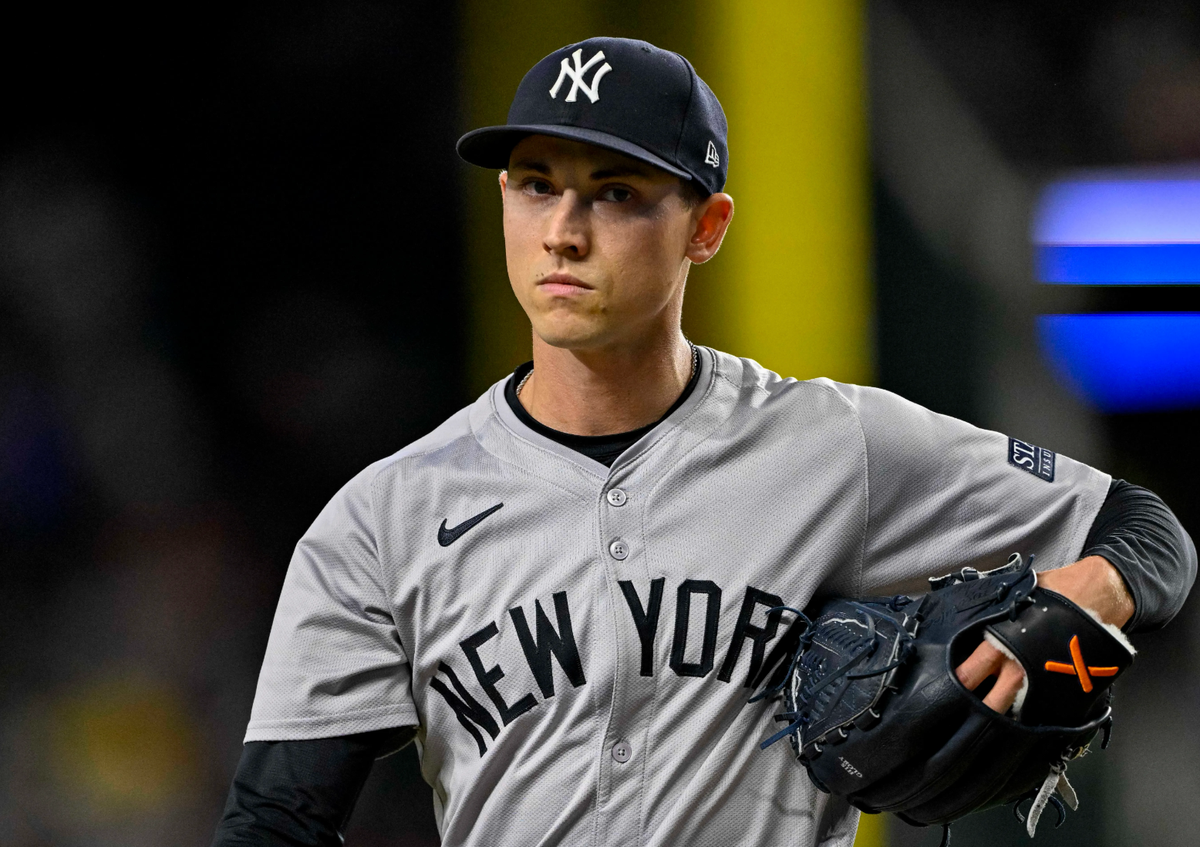
The Mets sign Luke Weaver
The New York Mets have signed Luke Weaver to a two-year, $22 million contract. The Mets will likely use Weaver as their eighth-inning guy, setting up for fellow former Yankee Devin Williams. He'll also be joining fellow former Yankees Clay Holmes and Juan Soto. All of whom will play under former Yankees bench coach Carlos Mendoza. I'm beginning to sense a pattern here!
Weaver, a ten-year veteran, is coming off a 2025 campaign in which he posted a 3.62 ERA (113 ERA+) in 64 appearances while striking out 72 batters and walking 20 in 64.2 innings. He was better in both 2023 and 2024, and I suppose that's the Weaver the Mets hope they're getting. There was a lot of reporting late in the season that Weaver was tipping his pitches, so maybe they will get that guy back with a small adjustment or two.
Also: I'd like to know why every team has decided that almost every free agent of note should be paid $11 million a year in 2026. It feels like every other deal has been for an AAV of $11 million.
Phillies sign Brad Keller
The Phillies have signed reliever Brad Keller to a two-year, $22 million deal. See! I told you! They're all making $11 million annually!
Keller enjoyed the best season of his career for the Cubs in 2025, posting a 2.07 ERA (187 ERA+) while striking out 75 batters and walking 22 in 69.2 innings across 68 appearances. He had thoracic outlet syndrome surgery a couple of years prior and he struggled through 2024 while trying to get right, but he seems to be one of the success stories as far as that procedure goes.
Keller will be a setup man for Jhoan Duran in the City of Brotherly Love. And in road games too. I mean, it'd be weird if he only set up for Duran at home.
A Twins ownership shakeup
The Minnesota Twins announced yesterday that (a) they have formally accepted three new limited partners to their ownership group; and (b) that Tom Pohlad is replacing his younger brother, Joe Pohlad, as the named owner/control person of the ball club. Joe Pohlad said in the team's statement that he will be, "stepping away from my day-to-day role." There was a lot of chatter that he was really pushed, though. I'm not really up on my Target Field Kremlinology, though, so maybe go read about it from Gleeman at The Athletic if you want some detailed info.
Here are the new limited partners, who the Twins pursued earlier this year after reversing course on their plans to sell the team outright:
- George G. Hicks, the co-founder of an investment firm called Varde Partners, which specializes in "distressed properties," so line up on the right to make your Twins jokes. Hicks is a Minnesota native and a self-described "lifelong Twins fan"
- Craig Leipold, the majority owner of the NHL's Minnesota Wild; and
- Glick Family Investments, a New York-based private equity.
Dan Hayes of The Athletic reports that the Pohlad family sold more than 20% of the franchise in this deal, and that the share price represents an overall team valuation of $1.75 billion. The Twins were carrying a reported $500 million in debt with they had long cited as a big reason for carrying a low team payroll. There were no assurances in the team statement, however, that their new debt-free existence will translate into high player salaries. Because, really, why would they ever say that?
Is that good?
The wrongful death lawsuit brought by Tyler Skaggs' family against the Los Angeles Angels went to the jury earlier this week. As any trial lawyer will tell you, once a jury has a case you never really know what's gonna happen.
Except sometimes you get some pretty strong hints:
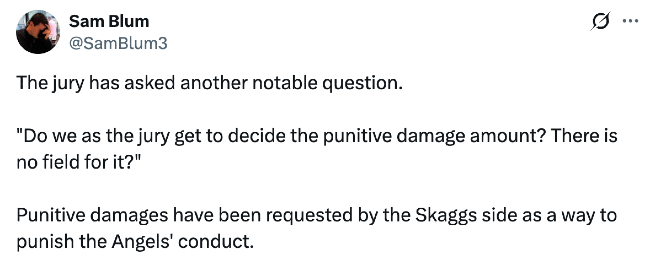
Call me crazy, but I feel like they wouldn't be asking that question if they weren't about to blast the Angels back to the stone age, financially speaking.
If Arte Moreno doesn't make a massive settlement offer before that jury comes back he's even dumber than almost all of his baseball decisions suggest that he is.
Other Stuff
Quote of the Day: Christopher Anderson
Yesterday I linked that Vanity Fair story which featured Chris Whipple's unhinged conversation with Trump's Chief of Staff, Susie Wiles. The article was accompanied by a series of portraits of Wiles, JD Vance, Marco Rubio, Karoline Leavitt, Stephen Miller and other top Trump brass, which were taken by photographer Christopher Anderson.
The photos caused almost as much of a stir as the interview in that they were profoundly unvarnished, with the marks from Leavitt's lip injections and Vance's and Rubio's gross pores clearly visible in extreme closeups. In the wider shots Trump's people looked like sullen children roaming unattended around a particularly sad business hotel. Photographers are artists and journalists rolled up into one and they tend to know exactly what they're doing, so a lot of people wondered about Anderson's methods and motivations for the shoot.
Yesterday the Washington Post got Anderson on the phone and asked him about the photos. And, to his great credit, he stood behind them, strongly. Which wasn't hard, as Anderson explained – and the Post linked – multiple past works, including photos of Trump himself and Obama and others which adhered to the same aesthetic. Anderson's whole thing, he explained, is trying to get past the stage-managed part of politics and celebrity to show our leaders unguarded and not professionally packaged. He photographs what he sees, and to touch the photos up or hide flaws would be an act of propaganda. In light of that the Trump folks knew what they were getting into or, at the very least, they should have. For her part, Leavitt had her own hair and makeup person with her for the shoot, so if she looked terrible, it's kinda on her.
My favorite part of the interview, however, was this:
Washington Post: Were there moments that you missed? Anything that happened that’s on the cutting room floor?
Anderson: I don’t think there’s anything I missed that I wish I’d gotten. I’ll give you a little anecdote: Stephen Miller was perhaps the most concerned about the portrait session. He asked me, “Should I smile or not smile?” and I said, “How would you want to be portrayed?” We agreed that we would do a bit of both. And then when we were finished, he comes up to me to shake my hand and say goodbye. And he says to me, “You know, you have a lot of power in the discretion you use to be kind to people.” And I looked at him and I said, “You know, you do, too.”
That's some King Shit right there, brother. I presume that went right over that little Nazi's head, but I'm glad someone said it to him.
The Oscars are moving to YouTube in 2029
The Academy Awards have been televised since 1953. The ABC network has broadcast them for most of those 72-years, doing so from 1966 through 1970 and then then again from 1976 through the present day. ABC's current contract with the Academy runs through 2028, which will given them 56 straight years of Oscar broadcasts and 61 years overall. Yesterday, however, it was announced that the Academy Awards will not be broadcast on television at all starting in 2029. They will be on YouTube through at least 2033.
I'm no expert on broadcasting or technology. Maybe this really is the future. Maybe linear TV is a dead platform walking. Could be. Often feels like it is. But given how the streaming of widely viewed live events has gone so far, I'm guessing that this will cheapen and enshittify the Oscars product, at least in the short term. And will make the Academy Awards – one of the last enduring bits of the 20th century monoculture – into a niche product that people really don't give all that much of a shit about.
Maybe that's fine? I've been watching the Oscars since I was a little kid (I was a weird little kid) and I can rattle off Oscar history and trivia to you all day long. But on some level I have come to view the Oscars the same way I view the Baseball Hall of Fame. Something isn't better or worse on merit simply because it gets honored by a flawed but nonetheless established process later. Indeed, I've come to believe that treating the Oscars as the only seal of approval which truly matters blinds us to a lot of good films in the same way the Hall of Fame endorsement causes us to forget a lot of old ballplayers who don't make the cut for whatever reason. And it's way worse to do that with art, which can only be quantified commercially as opposed to substantively, than it is to do it with sports.
So I don't suppose I can get too worked up by the move, as it may be a good thing for art in the long run. But it's probably a pretty bad thing for the Academy, which will likely become less-and-less relevant over time by virtue of its decision.
Wanna make ChatGPT more annoying?
Wired reports that there is an online marketplace that sells code modules that simulate the effects of cannabis, ketamine, cocaine, ayahuasca, and alcohol when they are uploaded to ChatGPT. Basically, it turns your little chatbot into a simulacrum of a drunk or high person.
I'm guessing most of us have had the, uh, privilege of talking to someone who is drunk, baked, tweaked, or gakked up when we ourselves are stone cold sober. And I imagine that most of us would agree that it's among the more annoying and/or exhausting experiences imaginable. It's even worse when the wasted person has information we're seeking, thereby requiring that we interact with them. It can be a completely maddening ordeal.
And now I learn that there are people willingly seeking that experience out! We live in an amazing time.
A "lawsuit twist"
Three years ago Donald Trump sued the Pulitzer Prize Board for libel for giving awards to the New York Times and Washington Post for their journalism reporting on Trump's ties to Russia. Well, technically he sued the Board for issuing a public statement standing by its previous decision to make those awards, but that's basically the same thing. The important part here is that like so many of Trump's other lawsuits it's patently baseless and it's reflective of his desire to intimidate anyone and everyone who says bad things about him despite their manifest truth.
The lawsuit has slowly wound through state court in Florida over the past couple of years, with a number of motions being filed, but it's finally gotten to the discovery phase. Which, hey, that's actually good because that's where the bullshit public posturing stops and the actual business of digging into the substance of a case begins. It's where the parties begin to whittle the case down to the real issues at play if, indeed, there are real issues at play. It's where the liars and frauds who file spurious complaints and the obfuscators and foot-draggers who attempt to dodge accountability have to put up or shut up, and they have to do so under oath.
The Pulitzer Prize Board is, quite obviously, represented by competent counsel, because they have propounded discovery requests to Trump which, one strongly suspects, Trump has absolutely no desire to answer. Here is the most notable of the requests, as reproduced in The New Republic, which reports on the case:
“To the extent You seek damages for any physical ailment or mental or emotional injury arising from Counts I-IV of Your Complaint, all Documents (whether held by You or by third parties under Your control or who could produce them at your direction) concerning Your medical and/or psychological health from January 1, 2015, to present, including any prescription medications you have been prescribed or have taken,” the board wrote in their filing. “For the avoidance of doubt, this includes all Documents Concerning Your annual physical examination. To the extent you do not seek such damages in this action, please confirm so in writing.”
These are wholly relevant requests given that Trump is asserting physical and psychological damage as part of his complaint. They're bog standard "put up or shut up" requests which speak to essential elements of the claims that even a first year litigation associate would know to include in a set of document requests and interrogatories. Indeed, to not include such requests would, in my view anyway, be malpractice.
Which makes the way these requests are being reported on sound so crazy!
The New Republic, for example, calls them a "twist." A Google search reveals other outlets treating these requests like they're headline news or some out-of-nowhere surprise tactic. When, again, this is simply how one responds to claims of emotional or psychological injury. The very point of discovery is to determine the evidence, if any, a litigant has for a claim or a defense, and that's what these queries do.
I suppose it's easy to forget that when it comes to recent Trump lawsuits, given that his targets, which have included CBS, ABC, and a bunch of law firms, have chosen to simply bend over for him and pay him off rather than fight. But this is how it works when someone is actually fighting back against a bullshit claim. Indeed, it's how litigants always fought back against Trump himself in his decades worth of bullshit lawsuits prior to his entry into politics, a great many of which he lost in embarrassing fashion. It's part of why he filed for bankruptcy a bunch of times and was reduced to selling steaks, neckties, and diplomas from a scam university and accepting offers to be the host of a second-rate reality show. He's bad at legitimate business, he sues when he's losing, and he tends to lose the suits because they're baseless.
Nothing has really changed about his more recent lawsuits. They're all bullshit. It's just that his power and corruption, combined with his targets' cowardice and corruption, have lined up nicely to create extortion opportunities for him. Which may make the fact that The Pulitzer Board is actually fighting back seem like a newsworthy "twist," but this is simply how the process is supposed to work. And I suspect that, in the end, Trump won't much like how it works in this case.
The Shrimp Basket
I don't share feel-good stories very often, but I couldn't pass this one up.
About ten years ago a man named Charlie Hicks walked into The Shrimp Basket restaurant in Pensacola, Florida and ordered a bowl of gumbo. While he was there he began watching a baseball game that was showing on the TV. He struck up a conversation with the restaurant's chef, Donell Stallworth who, like Hicks, is a baseball fan. Hicks obviously liked the place because, from that day on, he came into The Shrimp Basket almost every single day, becoming a regular.
This past September Hicks didn't come in one day. Someone at the restaurant called him and he said he was sick, so he wouldn't be in. Stallworth had a bowl of gumbo sent to him. Hicks still didn't come in for a few days so someone called Hicks again to check on him, but he didn't answer. Stallworth felt something must be wrong, so he went to Hicks' apartment to check on him, but no one came to the door. As Stallworth was turning to leave he heard a faint cry for help through the door. It was Hicks – who is 78 years old – who had fallen and broken some ribs. He couldn't get up and he was severely dehydrated. Stallworth called 9-1-1, gave Hicks some water while waiting for the paramedics, and Hicks was saved. Hicks, a self-described loner, has no family who would've checked on him. He likely would've died if it wasn't for Stallworth.
But it gets even better.
While Hicks was in the hospital, the lease on his apartment was about to run out and the rent was about to go up to a level which he could not afford. So the folks at The Shrimp Basket sprung into action:
Shrimp Basket general manager Casey Corbin — who said Hicks is like the restaurant’s “adopted grandpa” — noticed there was an empty apartment next door to the restaurant, so she inquired about the rent. She was able to secure it for Hicks, and the landlord brought the lease to him in rehab so Hicks could sign it and make a payment.
“There were a few things that needed to be done before he moved in,” Corbin said. “It was taking a little bit longer than I liked, so I was like, what can we do to make this process happen faster?”
Corbin and her staff ended up helping out with the renovations, cleaning and setting the apartment up for when Hicks got out of rehab.
Corbin got him a walker too, and everyone at the restaurant signed it. Hicks is back to good health and is back to the Shrimp Basket every day.
I don't share these kinds of stories often because I'm not, temperamentally speaking, a very sentimental person. And while I don't consider myself to be overly-cynical or pessimistic, I often read stories along these lines that raise questions no one seems all that interested in answering. You know, the "employees donate comp time to sick coworker" or "little kid mows lawns to help pay for his sister's medication" or whatever. Stories which wouldn't exist if not for some deep flaw in our society that no one will address.
But this one got to me, folks. This one was about human connection in a world that increasingly thrusts people into isolation. Human kindness in a callous and unkind age. Human goodness when we're presented with so many examples of evil that, inexplicably, get rewarded more than goodness ever does.
It's good to be reminded that people still do care about one another. More so than most of us realize. It brought a goddamn tear to my eye.
Have a great day everyone.
Comments ()