
Cup of Coffee: March 26, 2026
The first game of the season, where to find the games, base coaches are pissed, old umpires are not pleased, some more bad business from the Tigers front office, and watching the fall of the American Empire

Good morning! Welcome to the real Opening Day – last night was just kind of weird – and, of course, welcome to Free Thursday:
Those of you here just to look around should know, my 25% off sale will disappear tomorrow, so act now or you're just burning money. Or something.
And now . . . on with the 2026 Championship Season!
And That Happened
Here are the scores. Here are the highlights:
Yankees 7, Giants 0: Nothing says "Opening Day" like a Wednesday night interleague game on a streaming service, prefaced by a half hour of screaming hype men, people dancing on taxis and cablecars, professional wrestlers and other assorted horseshit. The game did eventually get under way, but that was much to the chagrin of the Giants and their fans because they got their clock cleaned and looked like butt doing it.
The Yankees were first-pitch swinging all night and lit up Logan Webb for seven runs – six earned – on nine hits. Meanwhile Giants bats did bupkis against Max Fried who tossed six and a third shutout frames. Three Yankees relievers combined to finish the three-hit shutout. It wasn't a fun night for everyone on the Yankees – Aaron Judge struck out four times for the old Golden Sombrero – but I think everyone involved will take a laugher of a win on Opening Day followed by a day off to fart around in San Francisco.
Notes:
- The day after MLB entered into a partnership with Polymarket, the first image after the game began was of two dudes right behind home plate wearing highly visible, fluorescent green t-shirts with "Kalshi" written on them. I'm sure Rob Manfred and the Polymarket guys loved that;
- The Netflix scorebug is weird and busy and has a font so small that no one could read it:
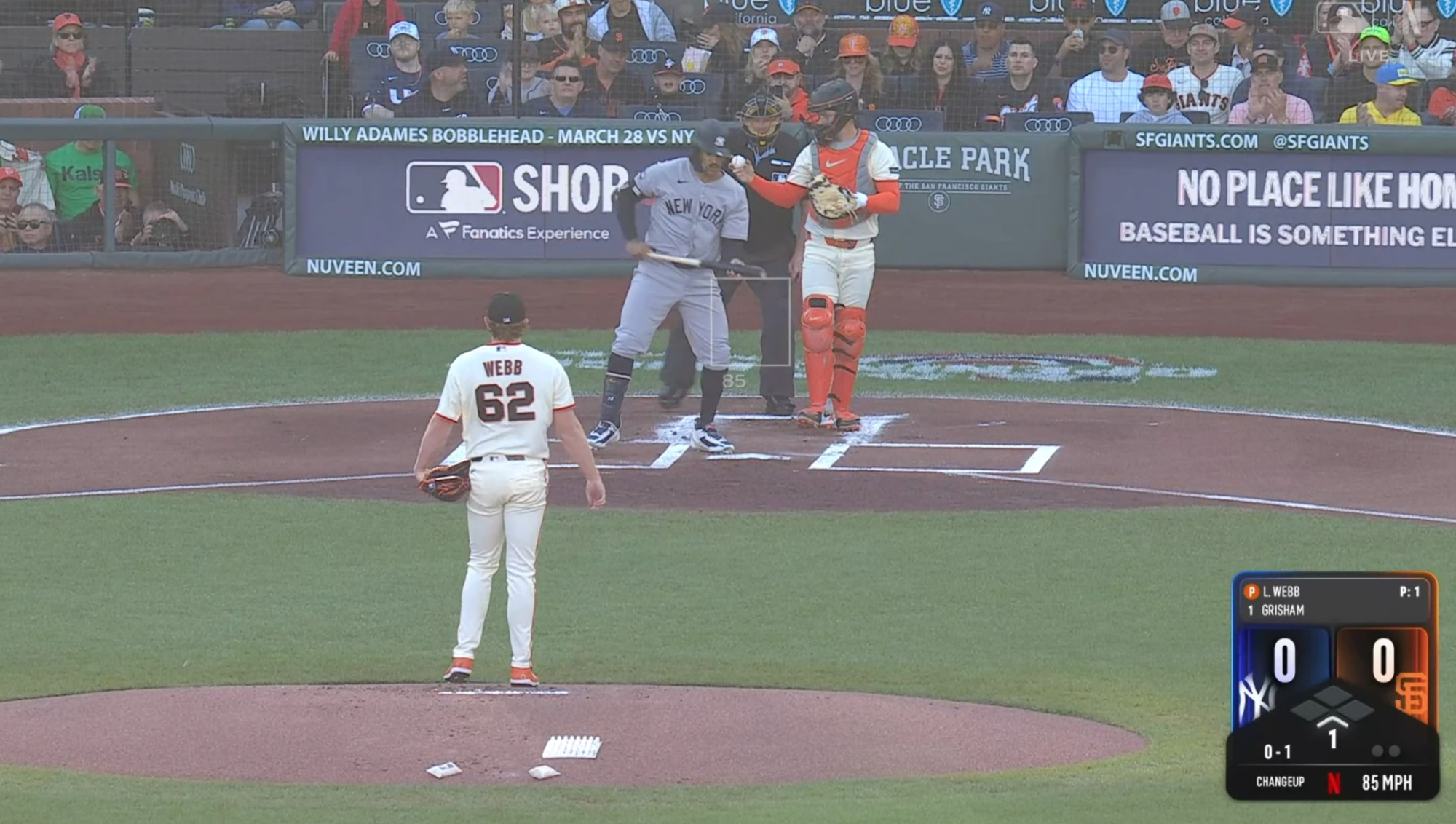
- Netflix missed the first-ever ABS challenge in the majors because they were interviewing Giants manager Tony Vitello about what adjustments Webb needed to make or whatever the hell. We were all denied being witnesses to history;
- The Netflix booth interviewed people all damn game long, actually. Jazz Chisholm. Both managers. That guy in the kayak out in McCovery Cove. Rob Manfred. Barry Bonds. Jameis Winston for reasons that were never entirely clear. It'd be amazing if a national broadcast of a significant baseball game actually gave a shit about the baseball game, but I suppose Netflix has more important priorities;
- The Manfred interview took place in the bottom of the fifth. I muted it because, like Trump, I've gotten to the point where I can't even stand to hear the guy speak. But I was happy to look up and notice that it was a quick 1-2-3 inning after which Manfred peaced out. I suppose that went as well as one could hope;
- I realize I complain a lot about national broadcasts, but the Netflix production was a new low. They cropped out runners on second base. The cameras missed stuff almost every inning. The constant interviews were super distracting. That scorebug was legitimately a problem too. Like when Webb was struggling in the fifth I wanted to check his pitch count and legit had to get up and move closer to the TV just to see it.
Netflix's baseball coverage is not at all ready for prime time. Which isn't when the first game should be played anyway. Let's pretend that it didn't happen. The 2026 season actually begins with the Pirates and the Mets this afternoon. Cool?
The Daily Briefing
Finding the games
Last night's game was on Netflix. Today's national games are on NBC or Peacock. There are all manner of new streaming products depending on what team you follow. It's getting rather hard to know where games are without looking it up anymore.
I feel like a back-in-my-day ranting crank when I complain about that kind of thing, but you have to admit, it's getting out of hand. FI mean, take this from The Athletic's "Money Call" newsletter:
If you’re a Yankees fan, you could need access to up to nine other networks to watch your team’s regular-season and playoff games this season, which translates to at least five separate subscriptions. Just a decade ago, you needed … cable.
Sometimes the back-in-my-day ranting cranks aren't wrong?
MLB base coaches are not pleased
From The Athletic, we learn that this year a directive has come down from Major League Baseball that first and third base coaches can no longer hang out outside of the coaches boxes behind the bags. They must remain inside of them when not whispering in a baserunner's ear or collecting his elbow pads or whatever. The reason: people think the coaches, who routinely range towards the outfield grass, have been relaying pitching grips and catcher setup location to hitters and that keeping them in the box will cut down on that.
The coaches are taking issue with that for a pretty good reason: they don't want their heads taken off by line drive foul balls:
“That’s a dangerous situation,” said Cleveland Guardians first-base coach Sandy Alomar Jr., who is entering his 17th season on the Guardians’ staff. “Imagine José (Ramírez) hits a ball 115 mph, pull side. You don’t have time to react.”
Base coaches in the past often drifted farther out, toward the outfield.
“Every third base coach, we’ve all been talking about how you’re constantly in danger,” said Chicago Cubs third-base coach Quintin Berry. “You never get a chance to get out of there. You can’t get out of harm’s way, ever. And I get what they’re trying to do. But you’re not going to stop anything by putting people in a box.”
Many managers and coaches empathize with the desire to clean up wrongdoing. But some also worry the league has introduced a different problem along the way.
What, Major League Baseball not considering unintended consequences of its actions? Heaven forfend.
My guess is that there will be grudging compliance with the new coach-in-the-box directive in the early going but that it will be totally abandoned before Memorial Day. Maybe because no one truly cares. Maybe because Sandy Alomar almost gets his head taken off by a José Ramírez foul ball.
Old umpires are not pleased
As you know, the ABS system – the roboump – is now a part of major league baseball. There has been little if any complaining about it during spring training and it seems like most everyone has accepted it well enough. But not retired umpire Richie Garcia! He's appalled!
"I think it's embarrassing, embarrassing to the umpires that are calling the game. Nobody likes to be humiliated in front of 30,000, 40,000 people," said Garcia, a major league umpire from 1975 to 1999. "What Major League Baseball is saying is: I don't trust the umpire's strike zone, so I'm going to use something that's going to be operated by some computer geek that knows nothing about baseball, and he's the one that's going to measure this and measure that because he's got a Ph.D. in physics or whatever the hell he's got a degree in."
Garcia is 83 years old and has been retired since Bill Clinton was in office, so his opinion on this doesn't really matter. Indeed, the mere fact that the Associated Press reporter sought out and then printed Garcia's comment on this almost seems cruel. It'd be like my son asking my dad his opinion of 2Slimey or something. He knows nothing about him, has nothing to do with him, and his opinions about him are pretty irrelevant.
The ABS system has been in place in the minors for several years now. It's a total non-issue in practice. To the extent it becomes a "storyline of the 2026 season" or something controversial it'll almost certainly be because some reporter or TV or radio personality or producer wants to create content out of it.
Let it go. It's fine. The roboump will not even make the top-five in terms of impactful and annoying rules changes from the past decade by the time it's all said and done.
The Tigers front office continues to foster a hostile workplace environment
Last fall, The Athletic reported that eight men employed by the Detroit Tigers, its business arm or its broadcast partner had been accused of misconduct toward women since 2023. The allegations against the men ranged from offensive comments to physical confrontation. In the wake of all of that, which included multiple firings, Ilitch Sports and Entertainment CEO Ryan Gustafson, sent an email to employees in which he said that he was “grateful” to those who came forward to share their experiences and said, “your courage helps make our workplace culture better, safer, and more welcoming for all.”
Based on a new report from The Athletic, Gustafson does not practice what he preaches.
Per Britt Ghiroli, a Tigers employee reported to his superiors that an interim vice president of fan experience and game day production named Matt Coy – who also, weirdly, serves as a consultant for a different company that works with other teams – was creating conflicts and making some employees feel uncomfortable by getting in their face and yelling, threatening their jobs, and invading personal space. The employee who lodged the complaint said that he did not feel like he could work with Coy under those circumstances and asked his superiors to do something about it.
And they did. They fired the whistleblower:
Days later, the employee was informed on a call with a supervisor and a human resources representative that the email had been interpreted as his resignation letter. After 18 years, his time at IS+E, working for a team he grew up cheering for, was over.
“They say they want people to talk. They commend people for coming forward. I spoke up and got fired,” said the employee, who The Athletic granted anonymity out of fears of possible retaliation by the organization.
The whistleblower's email was sent on February 9. A few weeks later, it turns out, Coy was moved to remote work-only after he was accused of making unwanted physical contact with female employees by placing his hands on their shoulders and screaming in employees' faces. I'm pretty sure the original whistleblower did not get his job back.
The Tigers look like they're going to be pretty good on the field this year. They look like pure dog shit in the front office, however.
Other Stuff
Watching the Fall of the American Empire

Iran is developing a new vetting and registration system for ships transiting the Strait of Hormuz as it transitions to a “selective” blockade of the strategic waterway, according to Lloyd’s List.
The maritime news and analysis service reported this week that several countries including India, Pakistan, Iraq, Malaysia and China, are in direct talks with Tehran to transit through its territorial waters in the Strait.
Which is to say that Iran is in the process of formalizing a permanent means of controlling the Strait, backed by a multilateral coalition that will undoubtedly favor every single country that's a part of it over the United States. It will give Iran the ability to continue its recently-adopted case-by-case approval of Strait transit, throttling oil supplies heading to the U.S. while leaving other countries unaffected. It's a setup that would've been impossible and unthinkable a month ago but which is happening now thanks to Trump launching an illegal and unprovoked war. If the Strait setup becomes institutionalized it will represent one of the biggest blows to the U.S. economy and U.S. power in the postwar period.
And honestly, what's to stop it? I fully expect Trump to try to ratchet up the violence in the region because all he understands is brute force, but anyone who knows anything about military power and military strategy – along with the degraded state of the U.S. military – knows that such a thing would be a losing battle. We're not going to take control of the Strait. We're not going to bomb Iran into surrender. We're only going to kill a lot of people while doing little if anything to change the status quo.
All of which fills me with an overwhelming feeling of déjà vu.
[Editor: You're going on another history jag, aren't you?]
Yes. Yes I am.
[Editor: That's two in one week, Craig. You wanna maybe pace yourself?]
Nah.
Ever since the Pandemic hit I've been writing about how we're in the dying days of the American Empire. We've never called it an empire, probably because with a few notable exceptions we've not exerted direct political control over other countries like empires have done historically. But thanks to our military, economic, and cultural hegemony America has exercised functional imperial power over much of the world since at least the end of World War II.
We can quibble over when the American Empire truly began to crumble, but a good argument can be made that our national mental break in the wake of 9/11 and that our disastrous wars in Iraq and Afghanistan were major signposts of imperial decline. To be sure, a considerable amount of political, social, and moral rot had set in well before that – I'd argue that it began during the Reagan years, when we decided that denying the existence of worldwide problems and insisting upon the exercise of coercion and might at the expense of soft power and multilateralism was the way to go – but the events of the 21st century exacerbated that rot to the point where we're now quickly crumbling.
I've been reading a hell of a lot of history over the past few years. Especially British history, because I've been trying to understand what it truly means for an empire to fall and what it means to live in a post-imperial society. History doesn't directly repeat, of course, and all manner of different and unexpected things are likely to occur on our current timeline that never happened with the British Empire, but I keep coming back to two general ideas that are largely informed by the experience of British imperial decline.
The first idea is that an empire's collapse is not something that the people living in it truly tend to notice as its happening. To citizens living in the imperial core, an empire falling doesn't necessarily disrupt their daily lives in any obvious ways. It may simply mean that, when the bridge into town needs to be repaired or replaced, no one comes to fix it like they always had. Or maybe the mail doesn't get delivered anymore. Or maybe manufactured goods cost a lot more or are harder to come by due to the degradation of trade, travel, and communication systems. If violence happens it tends to be out in the provinces. Otherwise, life goes on, even if it's a bit more inconvenient and less orderly than it was in the past. One need only scratch the surface of late 19th century and early 20th century British social histories, fiction, and the like to grok the fact that, despite all manner of objective measures which showed a weakening and even teetering British Empire, most of the late Victorians and Edwardians really didn't appreciate what was happening as it was happening.
In America's case it may very well be our infrastructure failing or our mail no longer getting delivered, but there are a lot of more modern signifiers we might expect. Stuff like Americans no longer being able to get medications as easy as people in other countries. Stuff like Americans no longer being able to take the quick customs line at European airports. Stuff like our goods and services becoming far more expensive and unreliable due to our inability to set the terms of world commerce and culture. Stuff like countries who would never dare directly challenge us in any number of international arenas before basically telling us to fuck off now. We're already seeing a lot of that kind of thing happening of course. I expect it will get way, way worse in the coming years and I suspect we would not be experiencing this but for America's decline.
The second idea is that empires have a lot of inertia and, as such, they carry on in name and even in certain aspects of power for a good while even after they're functionally over.
A good argument can be made that Britain, the unquestioned supreme world power since at least 1815 and the defacto supreme world power for a good century before that, had been eclipsed economically and culturally by the 1870s or 1880s, with both the United States and Germany having caught up to and passed it in terms of industrialization, innovation, and overall quality of life. The British military, too, was a shell of its former self by the end of the 19th century, with it losing wars and skirmishes – or, more often, archiving pyrrhic victories – in its colonies that a preeminent world power never should even have to fight in the first place let alone lose. Some of this decline was inevitable – you can only subjugate people for so long – but a great deal of it was a function of complacency, arrogance, and stupidity on the part of British leaders that sent the Empire spiraling downwards.
Yet the Empire carried on in name and, at least on paper, grew even larger in the early years of the 20th century. But it was an increasingly sick and hollow empire. It emerged victorious in the First and Second World Wars, but (a) it required considerable help in both instances; and (b) the wars utterly ruined them, financially, industrially, militarily and, frankly, emotionally and psychologically. Britain quickly began to grant independence to its colonies in the postwar period, in part because the colonial model was no longer seen as optimal, but mostly out of pure necessity. It simply could not govern them anymore, and its weakness in that regard allowed anti-imperialist voices both in the colonies and at home to, finally, win the day.
Appropriately enough given the news event which kicked off this little essay, Britain's last gasp as an empire was the Suez Crisis in 1956, in which it and France, deluding themselves into thinking that it was still the 19th century, tried to depose Egypt's leader and take control of the Suez Canal. It was a miserable failure, tactically, strategically, and politically. The two venerable powers utterly failed to achieve their goals. Indeed, they came out way worse than if they had never intervened to begin with. They withdrew under extreme pressure from the United States, which had warned them against trying to seize the Suez in the first place because doing it was stupid and doomed to failure. The episode conclusively demonstrated that the United Kingdom could no longer pursue its own independent foreign policy without consent from the United States and conclusively ended Britain's time as a preeminent world power.
Again, I understand that it is overly simplistic to make 1:1 historical comparisons, but my analogy-fixated lawyer brain cannot shake the notion that the United States has been speed-running the fall of the British Empire over the past 25 years or so. I can't shake the idea that our post-9/11 national mood was akin to the rise of self-defeating British Jingoism in the 1870s and that Iraq, Afghanistan and some of our other recent military adventures were equivalent to the British Empire's Boer Wars and the Siege of Khartoum. We've thankfully skipped over a couple of world wars, but what's happening in Iran right now feels to me very much like a Suez Crisis kind of deal. That time when, finally, everyone's realizing that they can stand up to the American bully, bloody its nose, and thereby end its pretensions to international supremacy. In reality, however, it was a supremacy it had already lost for all practical purposes.
I do not lament the fall of the American Empire or the fall of the British Empire before it. Empires are bad things in mere concept and, in practice, the British and American Empires have caused untold harm and suffering while doing little if anything to reflect upon or to atone for their acts. In America's case the Cold War gave us a theoretical moral and ethical framework for our behavior in the world, rife with high-minded concepts such as freedom over tyranny and prosperity combatting want. But we never came close to practicing what we preached in that regard, deploying those ideals cynically to the extent we ever deployed them at all. We've had the means and opportunity to do great humanitarian things on a scale the world had never seen before but, with a few isolated exceptions, we've largely chosen not to. The American Empire's ledger is covered with red and, despite some pretty damn good P.R. campaigns that argued the contrary, we've never shown much of a desire to even try to balance the books.
So no, I do not lament the fall of the American Empire. I believe that fall was avoidable at this particular point in time, and I wish it was winding down in radically different ways than it is given all of the death and suffering it has caused and no doubt will continue to cause over the coming years, but its end was inevitable. I actually think that America itself will be better, at least in the long run, for it ending. Or at least it can be. It can be if we learn from the calamities of the recent past and understand that we are merely part of this world as opposed to the protagonist of its reality. If we use our wealth, our resources, and our knowledge to build and discover things that work towards the betterment of humanity rather than devoting all of our energies to the business of domination and destruction.
I don't suspect I'll live long enough to see that project fully come to fruition if, indeed, it ever does. I mean, it's been 80 years since the British Empire fell and it's still trying to figure out how it fits in the world, with episodes of admirable post-imperial progress giving way to reactionary response and backsliding and then back round again. To this day there are people with no small amount of power and influence in the UK who talk as if they, personally, defeated Napoleon at Waterloo and Hitler in Europe, and that if they merely oppress the right people and protect the wealth and status of a select elite that The Crystal Palace will once again rise in Hyde Park and Britannia will once again rule the waves.
But the American Empire is dead, folks. It should not be eulogized, idealized, or mythologized. It must simply be buried. The work of the next several decades is to lay the groundwork for a new, post-imperial America of which our descendants can be proud. A new America which ensures that the American Empire will be forever thrown onto the ash heap of history.
Have a great day everyone.
Comments ()